At the end of May 2026, Statistics Netherlands (CBS) published the Cybersecuritymonitor 2025, which it prepares each year at the request of the Ministry of Economic Affairs. The main conclusion is encouraging, because fewer Dutch businesses are affected by cyberattacks than in previous years. For cybersecurity for SMEs, however, the figures show a more nuanced picture, and companies with 10 to 250 employees in particular have good reason to take a closer look.
Fewer cyber incidents in Dutch businesses
In 2024, 4% of Dutch businesses experienced a cyber incident caused by an external attack, compared with 11% in 2016. Over the same period, the share of businesses where such an incident also led to costs, for example because ransomware made systems unavailable, fell from 6% to 1%. These figures indicate that basic security measures have become more common and that they are effective.
Company size makes a clear difference
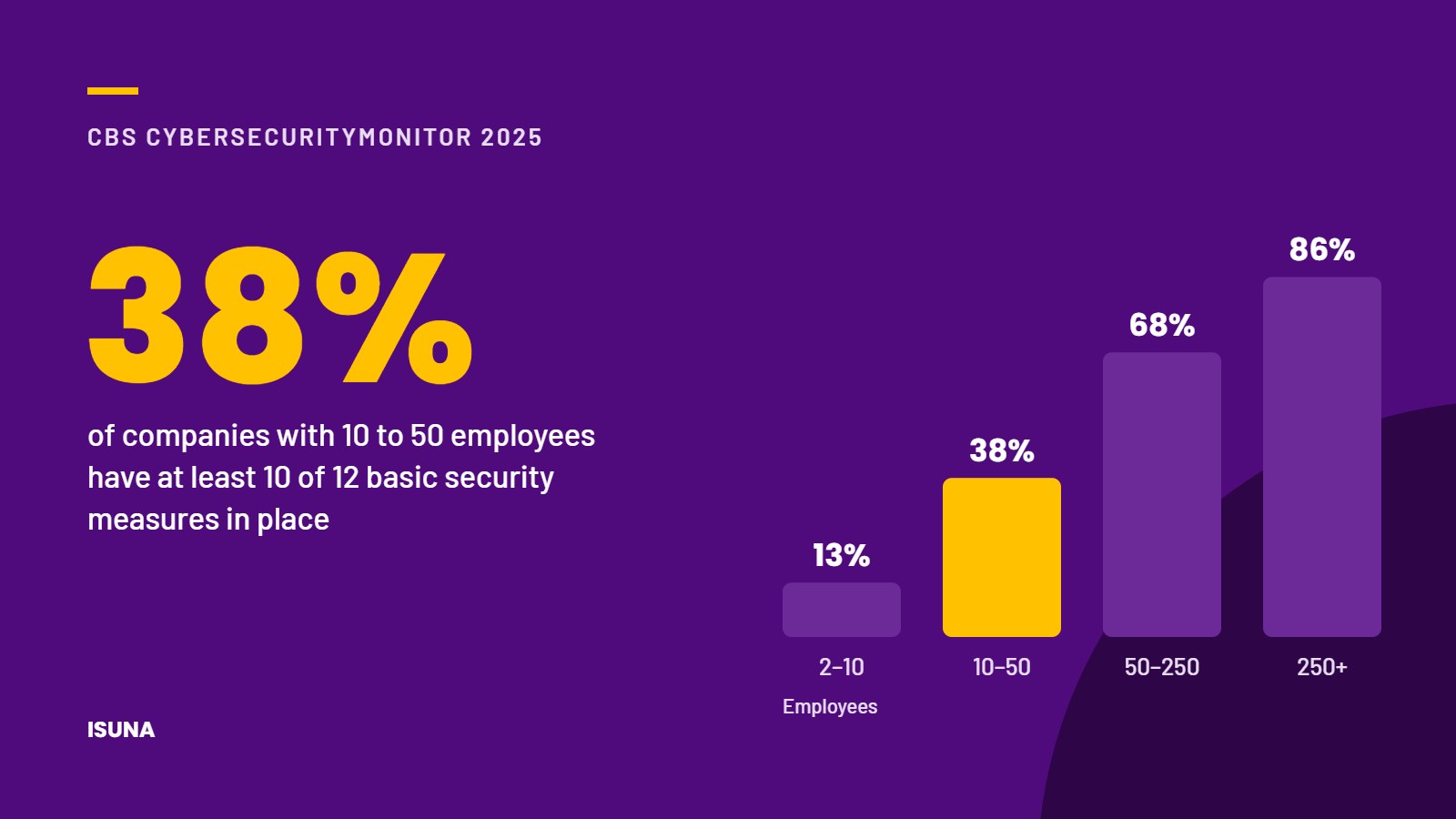
The picture changes considerably when the figures are broken down by company size. The table below shows the share of businesses that experienced an incident from an external attack in 2024, together with the share that had at least 10 of the 12 basic security measures surveyed by CBS in place in 2025.
| Company size | Incidents from external attacks (2024) | At least 10 of 12 basic measures (2025) |
|---|---|---|
| 2 to 10 employees | 3% | 13% |
| 10 to 50 employees | 6% | 38% |
| 50 to 250 employees | 8% | 68% |
| More than 250 employees | 16% | 86% |
Larger organisations are attacked more often, which is understandable given that they have more systems, more users and more valuable data. At the same time, they invest considerably more in protection, and 86% of companies with more than 250 employees have at least 10 of the 12 basic measures in place.
The largest gap can be found in the middle of the market. Companies with 10 to 250 employees already experience noticeably more incidents than the smallest businesses, yet only 38% of companies with 10 to 50 employees have most of the basic measures in place. Among businesses with 2 to 10 employees, 40% take 3 measures or fewer. The same pattern is visible in individual measures: data encryption is used by 33% of businesses with 2 to 10 employees and by 91% of the largest companies.
Cyber insurance remains the exception
Only 19% of Dutch businesses have insurance that covers cyber incidents. The share is highest in financial services at 40% and in ICT at 35%, and lowest in construction, transport and storage, and hospitality at 12%. For most companies, this means that the costs of an incident, from recovery work to lost revenue, are paid by the business itself.
A low number of incidents does not guarantee good protection
A low incident rate is a positive sign, but it does not automatically mean that a company is well protected. Organisations that do not actively monitor their systems are also less likely to notice an attack at an early stage. Business owners should therefore ask not only whether an incident has occurred, but also whether they would detect one in time and whether they would be able to restore their systems and data afterwards.
Basic security measures for companies with 10 to 250 employees
For most growing businesses, the measures with the greatest effect do not require large investments, although they do require consistent attention. The following measures form a solid foundation:
- Multi-factor authentication (MFA) on email, cloud applications and remote access, preferably with phishing-resistant methods such as passkeys.
- A fixed schedule for security updates, with priority for laptops, servers, firewalls and other systems that are reachable from the internet.
- Centrally managed and encrypted devices, so that a lost or stolen laptop does not lead to a data breach.
- Backups that are stored separately from the daily working environment and that are tested regularly by actually restoring data.
- Careful access management, including closing accounts on an employee's last working day and limiting administrator rights to the people who need them.
- Regular security awareness sessions for employees, with attention to phishing and fraudulent payment requests.
- A clear incident procedure that describes who takes decisions, who contacts the IT partner and who informs clients.
Conclusion
The CBS Cybersecuritymonitor 2025 shows that cybersecurity in Dutch businesses is improving, but also that SMEs with 10 to 250 employees still lag behind larger organisations. In many cases, the reason is not a lack of budget but the absence of someone who is responsible for IT security on a weekly basis. ISUNA fulfils that role as an external IT department and takes care of account and access management, device updates and encryption, backup checks, authentication, security awareness and incident support within the agreed scope. If you would like to know how your organisation compares with the CBS figures, we are happy to discuss your current situation with you.
Frequently asked questions
What is the CBS Cybersecuritymonitor?
The Cybersecuritymonitor is an annual report by Statistics Netherlands (CBS) on the cyber resilience of Dutch businesses and individuals. It is prepared at the request of the Ministry of Economic Affairs.
How many Dutch businesses experienced a cyber incident?
In 2024, 4% of Dutch businesses experienced a cyber incident caused by an external attack. Among companies with 10 to 50 employees the figure was 6%, and among companies with 50 to 250 employees it was 8%.
Which security measures are most important for SMEs?
The most effective basic measures are multi-factor authentication, regular security updates, encrypted and centrally managed devices, tested backups, careful access management, security awareness and a clear incident procedure.