
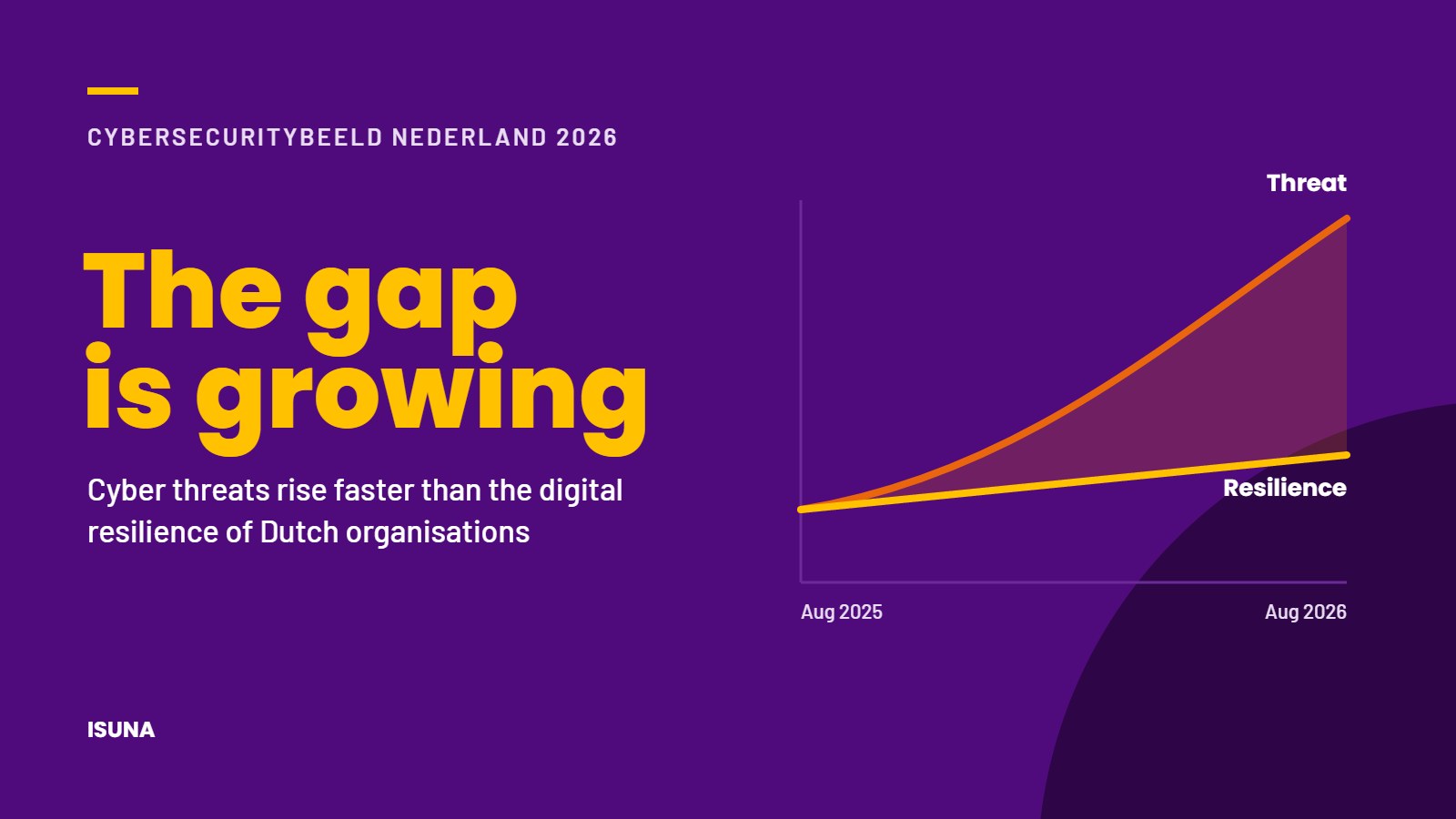
On 6 November 2026, the National Coordinator for Security and Counterterrorism (NCTV) published the Cybersecuritybeeld Nederland 2026 (CSBN), the annual assessment of the cyber threat to the Netherlands, also known in English as the Cyber Security Assessment Netherlands. The report covers the period from August 2025 to August 2026 and is based in part on information from the Dutch intelligence services AIVD and MIVD. Its central conclusion is that the capabilities and activities of state actors and cybercriminals continue to increase, while the digital resilience of Dutch organisations is not growing at the same pace. The NCTV describes this widening gap as a serious risk to national security.
The Cybersecuritybeeld Nederland 2026 is not written specifically for small and medium-sized enterprises, but several of its conclusions concern them directly. The NCTV states explicitly that SMEs are particularly vulnerable and need support in terms of resources and knowledge.
AI makes cyberattacks faster and more accessible
According to the NCTV, attackers use AI in every phase of a cyberattack, which increases both the speed and the scale of their attacks. AI also lowers the threshold for carrying out an attack, so that even attackers with limited technical knowledge are now able to do so. For businesses, this means that the number of attempts is likely to increase and that phishing messages and other forms of deception will be harder to recognise.
The time to install security updates must be reduced drastically
The CSBN 2026 notes that the time between the discovery of a vulnerability and its exploitation has decreased from days to, in some cases, a few hours. The NCTV therefore concludes that the time-to-patch, the time an organisation needs to install a security update, must be reduced drastically. A monthly update cycle is no longer sufficient for systems that are reachable from the internet, such as firewalls, VPN connections and remote access solutions.
More criminals focus on data theft and extortion
The NCTV observes that a growing number of cybercriminals focus on stealing data and then using it to extort organisations. This is an important development, because a good backup helps an organisation recover from encryption but does not prevent stolen data from being published. Protecting data against theft, through access management, monitoring and encryption, is therefore just as important as being able to restore it.
Basic security measures are still missing in many organisations
One of the most striking conclusions of the report is that many organisations still do not have their basic security measures in place. The NCTV names good patch management, backups and 24/7 logging, monitoring and detection as part of these basics, and states that the basics must be put in order quickly. The report also notes that ownership at board level, prioritisation and practising for incidents are lagging behind, and that business continuity must be tested.
In practice, this means that management in a growing company should know who is responsible for IT security, which measures are in place and whether recovery after an incident has actually been tested.
What the government is doing to support businesses
The cabinet has presented a new action programme for future-proof digital resilience, coordinated by the NCTV, which aims to strengthen digital resilience structurally over the coming year. The measures include better cooperation between government and businesses during incidents and crises, better preparation of SMEs for incidents, and a scanning service through which organisations can have their systems checked for vulnerabilities and act on the results immediately. The NCTV also calls on all organisations to check their situation against the basic principles of digital resilience published by the National Cyber Security Centre (NCSC) at ncsc.nl/basisprincipes.
Conclusion
The Cybersecuritybeeld Nederland 2026 shows that the cyber threat is growing faster than the resilience of Dutch organisations, and that SMEs are among the most vulnerable. The measures that the NCTV considers most urgent are not new: fast installation of security updates, reliable and tested backups, monitoring and detection, and clear responsibility at management level. For many companies with 10 to 250 employees, the challenge is to carry out these measures consistently without an internal IT department. ISUNA takes on that role as an external IT department and provides update management, backup checks, security monitoring and incident support within the agreed scope. If you would like to know how your organisation measures up against the basic principles of the NCSC, we are happy to review this with you.
Frequently asked questions
What is the Cybersecuritybeeld Nederland?
The Cybersecuritybeeld Nederland (CSBN) is the annual assessment of the cyber threat to the Netherlands, published by the National Coordinator for Security and Counterterrorism (NCTV). The 2026 edition was published on 6 November 2026 and covers the period from August 2025 to August 2026.
What are the main conclusions of the CSBN 2026?
The threat from state actors and cybercriminals is increasing, AI is making attacks faster and more accessible, and the digital resilience of Dutch organisations is not keeping pace. According to the NCTV, many organisations still lack basic measures, and SMEs are particularly vulnerable.
Which basic measures does the NCTV recommend?
The NCTV names good patch management, backups and 24/7 logging, monitoring and detection as part of the basic measures. It also recommends testing business continuity and checking the basic principles of the NCSC.