What is shadow AI?
Shadow AI is the use of AI tools by employees on their own initiative and outside the agreements made within the organisation. It usually starts with good intentions, for example when an employee wants to summarise a long document, improve the wording of an email or translate a contract. The risk lies in the information that is entered into these tools, which is why a clear AI policy for employees is becoming increasingly important.
Data breaches caused by AI chatbots in the Netherlands
In August 2024, the Dutch Data Protection Authority (Autoriteit Persoonsgegevens, AP) warned that entering personal data into AI chatbots can lead to a data breach. One of the reported cases involved an employee of a general practice who had entered medical data of patients into an AI chatbot. In December 2025, the AP issued a new warning after receiving dozens of data breach notifications related to AI chatbots, with more notifications in 2025 than in 2024. The warning followed a data breach at the municipality of Eindhoven, where employees had entered large numbers of confidential documents, including CVs and youth care files, into public AI tools over a period of 30 days.
The risk is not limited to personal data. Confidential client files, financial information and internal strategy documents can be exposed in the same way.
AI literacy under the EU AI Act
Since 2 February 2025, Article 4 of the EU AI Act has required organisations that use AI systems to pay attention to the AI literacy of their employees. In July 2026, the European Union adopted the Digital Omnibus on AI (Regulation (EU) 2026/1744), which entered into force on 27 July 2026 and amended the wording of this article. Organisations are now required to take measures that support the development of AI literacy, instead of ensuring a sufficient level of AI literacy for every individual employee. National supervisory authorities started supervising Article 4 in August 2026.
In practice, this means that employees do not need to become AI experts, but the organisation should be able to show that it has informed them about the responsible use of AI tools and that it continues to do so.
What an AI policy for employees should include
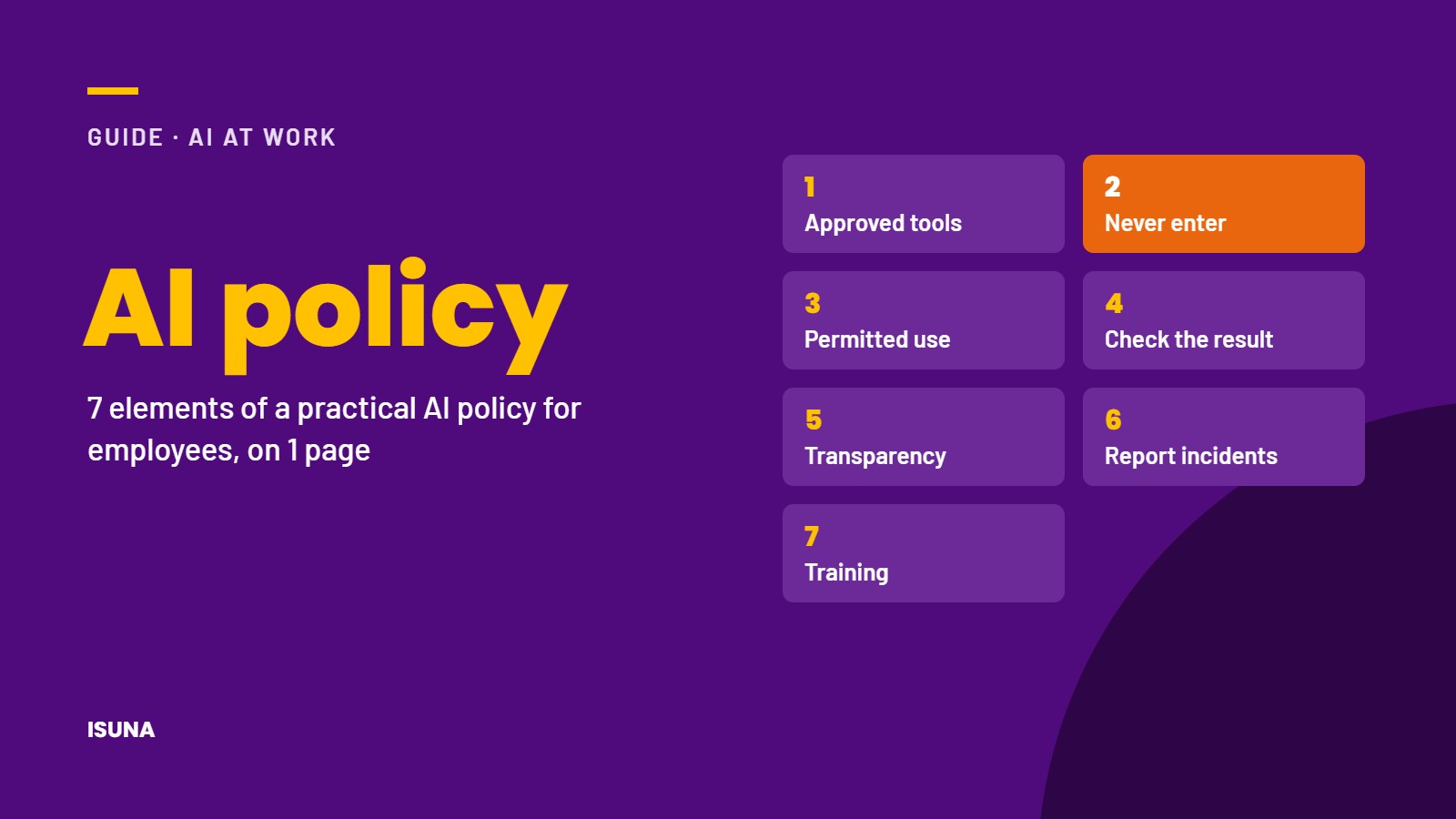
A practical AI policy can usually be described on 1 page and consists of the following 7 elements.
1. Approved tools
The policy names the AI tools that employees may use for their work. Business versions are preferable, because they usually offer control over user accounts and agreements about whether the data entered is used to train the model. Tools that are not on the list are not approved for work-related information.
2. Information that may never be entered
The policy contains a short and concrete list of information that may not be entered into AI tools, such as personal data of clients or colleagues, confidential client files, passwords and access codes, financial information that has not been made public, and contracts or legal documents, unless the tool has been approved for that purpose.
3. Permitted use
The policy also describes what employees may do, such as working with public information, editing their own drafts without personal or client data and asking general questions. A clear description of permitted use reduces the likelihood that employees look for their own solutions.
4. Responsibility for the result
AI tools can make mistakes and present incorrect information as fact. Everything that is sent to a client or used for a decision must therefore be checked by an employee.
5. Transparency
The policy states when the use of AI must be disclosed, for example when content is shared with clients or when AI plays a role in decisions about people.
6. Reporting incidents
If an employee has entered information that should not have been shared, it must be reported immediately to a designated contact person, without negative consequences for the employee who reports it. Under the General Data Protection Regulation (GDPR), a data breach that must be reported has to be reported to the AP within 72 hours, so a fast internal report is important.
7. Training and evaluation
New employees receive a short introduction to the policy, all employees receive a refresher once a year, and the policy is reviewed whenever new AI tools are introduced. A simple record of who has been trained and when serves as evidence of the measures taken.
Technical measures that support the policy
A policy only works if employees remember and follow it, and technical measures make the safe way of working the easiest one. Organisations can provide an approved AI tool so that employees do not need to look for alternatives, manage access to that tool through company accounts instead of private registrations, consider blocking unapproved AI websites on company devices, and apply data protection settings that warn or block employees when they try to share sensitive files.
Checklist for an AI policy
- The approved AI tools have been named
- The list of information that may never be entered has been agreed and shared
- A contact person for incidents has been designated
- A short AI awareness session has been held and attendance has been recorded
- Technical measures have been applied on company devices
- A date for reviewing the policy has been set
Conclusion
An AI policy for employees helps organisations benefit from AI tools while limiting the risk of data breaches. By naming approved tools, defining clearly which information may not be shared and supporting the policy with training and technical measures, a company with 10 to 250 employees can meet the expectations of the AP and the EU AI Act in a practical way. Policies for the responsible use of AI tools are part of ISUNA's Secure Work service, together with security awareness and data protection on devices. We help organisations select and configure approved tools, apply technical safeguards and organise awareness sessions within the agreed scope.
Frequently asked questions
Is an AI policy for employees mandatory?
The EU AI Act does not prescribe a specific AI policy, but organisations that use AI systems must take measures that support the AI literacy of their employees. A written AI policy combined with training is a practical way to meet this requirement and to demonstrate it.
Is entering personal data into an AI chatbot a data breach?
According to the Dutch Data Protection Authority, entering personal data into an AI chatbot can be a data breach, because the company behind the chatbot may gain unauthorised access to that data. This applies in particular when employees use chatbots in violation of the agreements made with their employer.
What should an organisation do if an employee has shared personal data with an AI chatbot?
The incident should be reported internally immediately and assessed as a possible data breach. In many cases, a report to the AP and to the people involved is required, and under the GDPR a reportable data breach must be reported to the AP within 72 hours.
This guide is general information and does not constitute legal advice.