How common is payment fraud in Dutch businesses?
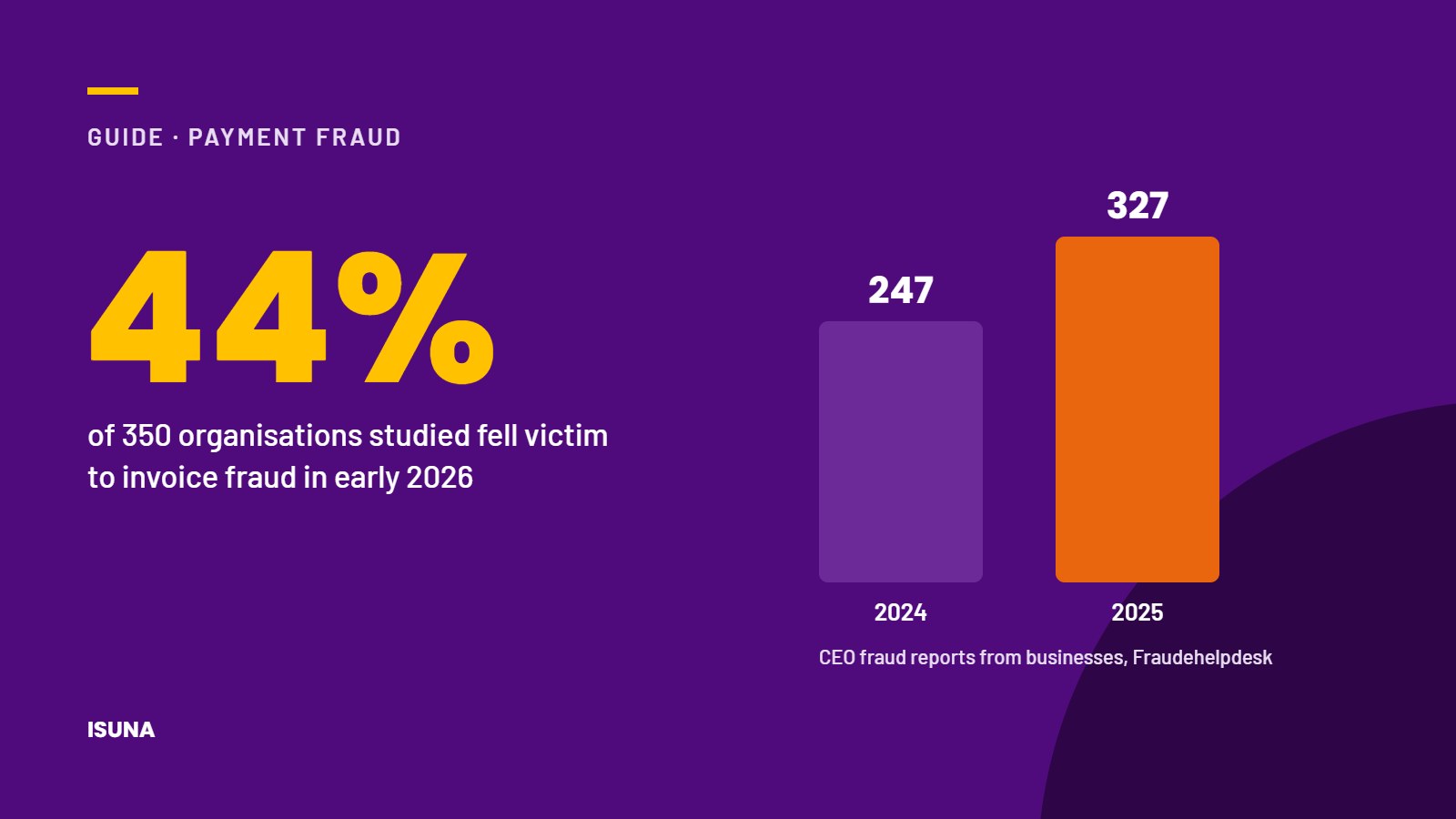
Invoice fraud has been the most common form of external fraud against businesses in recent years. According to the Netherlands Chamber of Commerce (KVK), research by credit insurer Allianz Trade showed that 44% of the 350 organisations studied fell victim to invoice fraud in early 2026. The Dutch Fraud Helpdesk (Fraudehelpdesk) received 327 reports of CEO fraud from businesses in 2025, compared with 247 in 2024, which made it the third most reported form of fraud against businesses that year.
Both forms of fraud rely on deception rather than technical vulnerabilities, which is why they can affect any company, regardless of how well its systems are protected.
How invoice fraud works
In invoice fraud, criminals send a fake invoice in the hope that it will be paid without being checked. The KVK distinguishes several variants:
- A copied invoice: a genuine invoice from a known supplier is copied, usually with only the bank account number changed. Criminals obtain such invoices, for example, through stolen post or a hacked computer or mailbox of the supplier.
- A ghost invoice: an invoice for a product or service that was never ordered, often for a small amount and in the name of a well-known company.
- A hidden offer: a document that looks like an invoice, but that turns out to be an agreement or subscription in the small print. This is also known as acquisition fraud.
How CEO fraud works
In CEO fraud, an employee who is authorised to make payments receives a message that appears to come from the director or another senior manager. The message asks for an urgent and often confidential payment, for example for an acquisition or an overdue supplier invoice. Criminals usually collect information about the company in advance, such as the names of managers and the way payments are approved, and they often use an email address that is almost identical to the real one. Increasingly, the email is followed by a phone call or voice message, and AI makes it easier for criminals to imitate the writing style or voice of the person they impersonate.
Warning signs of payment fraud
The following signs may indicate invoice fraud or CEO fraud:
- the bank account number differs from the one in your own supplier records;
- a supplier announces a change of bank account by email;
- the message emphasises urgency, confidentiality or consequences if payment is delayed;
- the request comes outside the normal payment procedure, for example directly from a director to an employee;
- the email address of the sender differs slightly from the usual address;
- the invoice or order number does not match your own records.
Verification of Payee: the name check on bank transfers
Since 9 October 2025, banks in the euro area have been required under the EU Instant Payments Regulation to check, before every SEPA transfer, whether the name of the recipient matches the IBAN. The payer is notified if the name matches, almost matches or does not match, or if the check cannot be carried out. This Verification of Payee is a useful additional safeguard, but it does not replace internal procedures. If the payer continues with a payment despite a warning, the bank may not be liable for the loss.
Payment procedures that prevent fraud
| Procedure | How to apply it |
|---|---|
| Verify every change of bank details by phone | Call the supplier on a number from your own records, never on a number mentioned in the email or on the invoice. |
| Apply the four-eyes principle | Payments above a certain amount and changes to supplier details are approved by 2 people. |
| Never deviate from the procedure for urgent requests | Agree that no employee will be blamed for checking a request, even if it appears to come from the director. |
| Match invoices with orders | Only pay invoices that can be linked to an order, a contract or a delivery. |
| Take warnings from the bank seriously | Do not continue with a payment if the name check shows that the name and account number do not match, until the details have been verified. |
Technical measures that support the procedures
Many cases of invoice fraud and CEO fraud start with a compromised mailbox, either at the company itself or at one of its suppliers. Protecting mailboxes with phishing-resistant multi-factor authentication (MFA), monitoring for suspicious forwarding rules and sign-ins, and using email authentication standards such as SPF, DKIM and DMARC make it more difficult for criminals to send emails on behalf of your organisation or to read along with your correspondence. Regular awareness sessions help employees recognise the warning signs described above.
What to do if a fraudulent payment has been made
If a payment has been made to a fraudster, act immediately. Contact your bank to try to recover the money, report the fraud to the police and report it to the Fraudehelpdesk. If a mailbox may have been compromised, inform your IT partner so that passwords can be changed, sessions can be ended and the mailbox can be checked for unauthorised forwarding rules. Keep in mind that the money cannot always be recovered, and that a genuine invoice that was replaced by a fake one still needs to be paid.
Checklist for preventing payment fraud
- Changes to bank details are always verified by phone using known contact details
- Payments and changes to supplier details require approval by 2 people
- Employees know that they may always verify urgent requests from management
- Invoices are matched with orders or contracts before payment
- Mailboxes are protected with phishing-resistant MFA
- SPF, DKIM and DMARC have been configured for the company domain
- Employees receive regular awareness training on payment fraud
- The procedure for a fraudulent payment is documented
Conclusion
Invoice fraud and CEO fraud remain among the most common forms of fraud against businesses, and AI makes the deception increasingly convincing. Clear payment procedures, verification of every change of bank details and well-protected mailboxes considerably reduce the risk. Security awareness and the protection of email and devices are part of ISUNA’s Secure Work and cybersecurity services, and we help organisations secure their mailboxes, configure email authentication and train employees within the agreed scope.
Frequently asked questions
What is the difference between invoice fraud and CEO fraud?
In invoice fraud, criminals send a fake or altered invoice in the hope that it will be paid. In CEO fraud, criminals pretend to be a director or senior manager and ask an employee to make an urgent payment.
How can I recognise a fake invoice?
Check whether the bank account number matches your own supplier records, whether the invoice can be linked to an order and whether the message contains unusual urgency. If in doubt, contact the supplier using details from your own records.
Does Verification of Payee protect against invoice fraud?
Verification of Payee checks whether the name of the recipient matches the IBAN and warns the payer if it does not. This helps detect fraud, but it does not replace internal checks, and a payer who continues despite a warning may bear the loss.
What should I do if I have paid a fake invoice?
Contact your bank immediately, report the fraud to the police and report it to the Fraudehelpdesk. If a mailbox may have been compromised, also inform your IT partner.
This guide is general information and does not constitute legal or financial advice.