Why a structured process for onboarding and offboarding matters
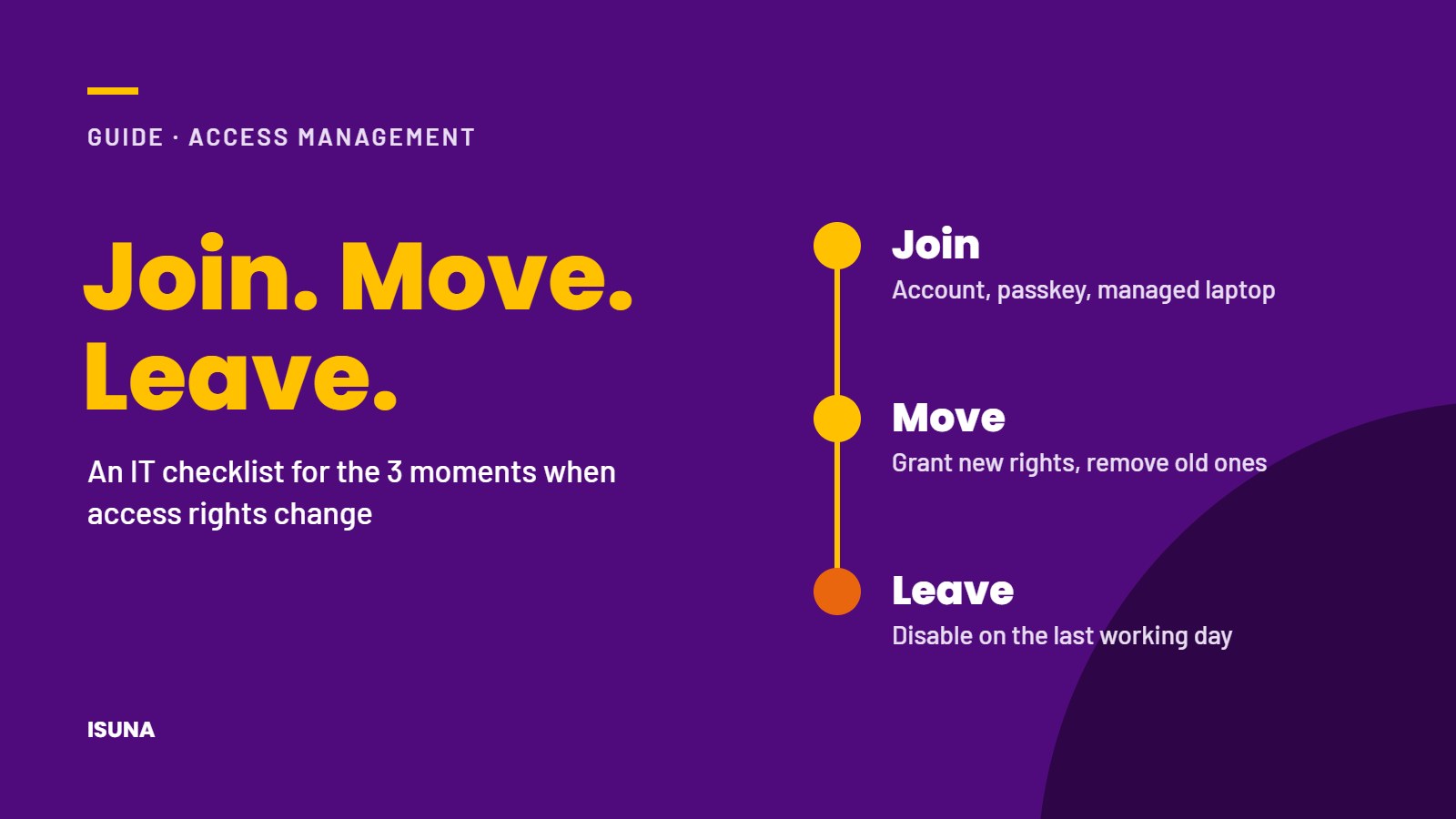
In a growing company, employees regularly join, change roles and leave. Each of these changes affects user accounts, devices, shared folders, licences and access to client systems. When these steps are not documented, mistakes are easily made: a former employee who can still read company email, a new colleague who has to wait 3 days for a laptop, or an intern who temporarily received administrator rights that were never removed.
Attackers are aware of these weaknesses. The Microsoft Digital Defense Report 2026 lists the use of valid accounts among the most common ways of gaining access to an organisation, and an account that should have been closed is still a valid account.
A clear process also has commercial value. Clients and prospects increasingly ask their suppliers how access rights are granted and removed, and a documented procedure for onboarding, role changes and offboarding makes it much easier to answer these questions.
IT onboarding checklist for new employees
- HR or the manager informs IT at least 1 week before the start date
- A personal user account is created, and shared login details are not used
- Access rights are based on the new employee's role and are not copied from a colleague
- Strong authentication, preferably with a passkey, is set up on the first working day
- A managed laptop and phone are prepared, encrypted and fully updated
- Approved software and licences are assigned
- A short introduction to IT security and the AI policy is scheduled in the first week
- The manager confirms after the first week that the access rights are correct
IT checklist for role changes
Role changes are the moment when access rights tend to accumulate unnoticed, because employees often keep the rights from their previous positions.
- The manager informs IT of the change and the effective date
- Access rights for the new role are granted
- Access rights from the previous role are removed, which is the step that is most often forgotten
- Administrator rights are reviewed and removed if the new role does not require them
- Shared mailboxes and distribution lists are updated
Employee offboarding checklist
- HR informs IT of the last working day as soon as it is known
- The user account is disabled at the end of the last working day, or immediately in the case of an unexpected departure
- Active sessions are ended and MFA methods and passkeys are removed
- The mailbox is converted or forwarded to the manager, as agreed
- Files and ownership of shared documents are transferred
- Access to client portals and external tools is removed, based on a list of systems kept for each employee
- Company devices are returned, wiped and reassigned or taken out of use
- Passwords of shared accounts that the employee knew are changed
- Licences are released
- The user account is deleted after the agreed retention period
Quarterly review of access rights
Once every quarter, managers review a simple overview of who in their team has access to which systems, with particular attention to administrator rights, financial systems and client data. They then confirm or remove each access right. This review usually takes about 1 hour and identifies the issues that the checklists may have missed.
3 principles for a reliable process
- A single starting point. HR, or the person responsible for recruitment, always informs IT, and no other route is used.
- A clear owner. A designated person or IT partner carries out the steps and records their completion.
- A complete record. Every change is recorded with a date, so that the organisation can provide evidence when a client or auditor asks for it.
Conclusion
An IT onboarding and offboarding checklist prevents access rights from accumulating and ensures that former employees no longer have access to company systems. For growing companies, a documented process also makes it easier to answer security questions from clients. User account and access management, onboarding and offboarding and device configuration are core parts of ISUNA's managed IT services. When an employee joins, changes roles or leaves, a single message to ISUNA is enough: we carry out the necessary steps and keep a record of every change within the agreed scope.
Frequently asked questions
When should a departing employee's account be disabled?
The account should be disabled at the end of the employee's last working day. In the case of an unexpected departure, the account should be disabled immediately.
What should an employee offboarding checklist include?
An offboarding checklist should at least cover disabling the user account, ending active sessions, transferring email and files, removing access to external systems, returning and wiping devices, changing passwords of shared accounts and releasing licences.
How often should access rights be reviewed?
We recommend reviewing access rights once every quarter, with particular attention to administrator rights, financial systems and client data.